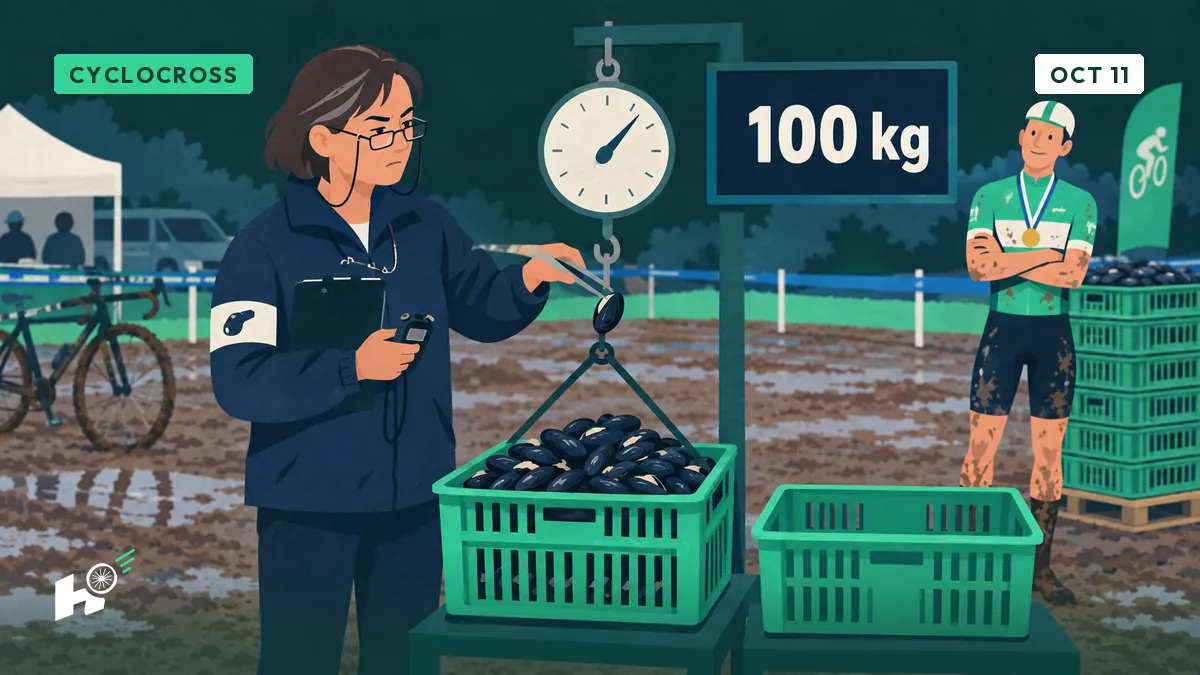

I got the tape measure out of the toolbox and ran it along the van, from the workshop stand to the back doors. Not for a bike. For mussels.
Lucinda Brand won the Mosselcross (the mussel cross) in Dendermonde, the first cyclo-cross of the season, and she takes home 100 kg of mussels. A hundred kilos. I have the workshop radio, the garden hose coiled up, three pairs of boots, two spare wheels and a bucket. I do the sums. The bucket, I have already emptied in my head.
The race itself was decided on the last of seven laps. Brand led by three seconds over Alvarado and seven over Betsema, and she accelerated on the last lap. Decisive acceleration, says Sporza. What I hear is a drivetrain that goes through every gear without hesitating when it counts, after six laps. That’s a clean chain. A clean bike is half the race already.
And I ask the only question nobody asks. Mussels are wet. A hundred kilos of mussels in a cross vehicle means seawater on the floor, next to the pedals and the bearings. Salt, where I work, is the headset’s enemy. Who rinses the floor, mind you? Who dries the bearings?
At ours, we’d have put the mussels in the car and the bikes on the roof. That’s the plan.
Rik may be right. But at what pressure in the tyres, with a hundred kilos in the boot? Nobody asked me that either.
I put the tape away. I greased the bearings on the club’s bikes, on principle, in case we ever win something that smells of the tide. What happens to the hundred kilos, I am not saying. It is not a bike part.
It’s true, we checked: Sporza.